How do babies learn?
Babies are born into a complex social world. Learning to navigate this is a lifelong process and begins with constant learning as a child. Through active participation in interactions with others, children develop an understanding of the world and of theirs and others actions, intentions, and feelings. The majority of this learning in the first year will come from you. Any time spent playing and communicating with your baby contributes to their learning! At Baby College® we stress the importance of eye contact, talking to your baby, and giving them plenty of your time and affection. Pretty much all of your baby’s life is an opportunity for learning, however we can categorise some forms of play that are especially educational.
Parent-led Play
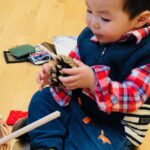
This type of play is primarily directed by the parent. For example, peek-a-boo is a form of parent-led play. This structured and repetitive interaction is a simple game that builds on what your baby already knows – that you will always be there! Many of the activities at Baby College® are forms of parent-led play. Here you can learn songs and games to take home and play together one-to-one. Your baby, especially in the younger classes, learns directly from you. They will imitate your facial expressions, and copy your language when learning social skills. The various activities help them learn to focus and concentrate, and most importantly, have fun!
Discovery or “Heuristic” Play
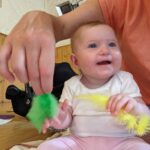
This type of play begins when a baby starts to move about independently and discovers the world for themselves. “Heuristic” comes from the Ancient Greek for “find” or “discover”, and is preceded by a process of trial and error that might not initially appear logical.
Heuristic, or self-led play, involves conceptual learning. Children will use and build upon their knowledge of the world around them and use this to interact with objects. Exploring the contents of your handbag or emptying the entire loo-roll onto the bathroom floor are examples of heuristic play! Pure heuristic play does not require the direct involvement of the parent but you still need to supervise and make sure the objects are safe and suitable. You may like to encourage and enhance this stage by providing a rich selection of environments to explore or make up a “Treasure Basket”.

Cognitive Play
Even though your child will increasingly assert their independence onto their play, as a parent you can of course still add to and enrich your toddlers learning opportunities. A good approach is to follow your toddlers lead and spot what they are interested in. Take features of an activity you know they enjoy and bring in some extra learning. Toddlers love to be independent and are learning to make their own choices, so it is great to encourage this and avoid overly asserting your control over their play.
The Montessori principles for example are useful for guiding you in how best to support your young child. It stresses the development of a child’s own initiative and natural abilities, especially through practical play.
“The teacher, child, and environment create a learning triangle. The classroom is prepared by the teacher to encourage independence, freedom within limits, and a sense of order. The child, through individual choice, makes use of what the environment offers to develop himself, interacting with the teacher when support and/or guidance is needed.
The goal of early childhood education should be to activate the child’s own natural desire to learn.”
– Maria Montessori
Imagination and Creative Play
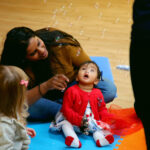
From around 18 months, children will start to use their imagination and experiment during play. This pretend play commonly occurs when a child gives agency to their toys, e.g. making a doll say or do something. Experimentation is a natural part of learning when outcomes or consequences are not yet fully understood. This can lead to some challenging behaviour, but is the start of a lifelong curiosity to learn and thus needs to be nurtured.
Engaging in imaginative play is great – and requires no expensive equipment or toys! For example, you can help children learn about potentially stressful unknown situations, such as a visit to the doctors, by role-playing games at home beforehand. You can even try reversing the roles and have your child play doctor.