✋🤚 Left or Right? How Hand Preference Develops in Babies 👶✨
Have you noticed your baby reaching for a toy with one hand more often than the other? Or perhaps they keep switching sides! The development of hand preference, or handedness, is a fascinating process — and one that unfolds gradually as your child’s brain and body mature.
When Does Hand Preference Begin?
From the earliest days, babies use both hands together in a rather uncoordinated way. You might see your little one grab a rattle with whichever hand happens to be nearest, or use both hands to explore a new texture.
By around 6–9 months, some babies begin to show subtle signs of preference — reaching more often with one hand, or holding food with one while using the other to steady themselves. However, for many, this preference can switch back and forth for years.
A consistent hand preference (either right or left) usually becomes clear by 3–4 years of age, but some children may continue to use both hands equally well for a little longer.
What Causes Handedness?
Hand preference originates in the brain’s hemispheres.
-
The left hemisphere controls the right side of the body and tends to specialise in language and fine motor control.
-
The right hemisphere controls the left side and contributes more to spatial and visual-motor awareness.
Most people (around 9 in 10) are right-handed, reflecting dominance of the left hemisphere, but genetics and experience both play roles. If both parents are left-handed, there’s a higher chance their child will be too — though it’s never guaranteed!
Why Do Some Children Use Both Hands?
Children who continue to swap hands well into preschool age are not necessarily behind — they may simply be still developing bilateral coordination (using both sides of the body together).
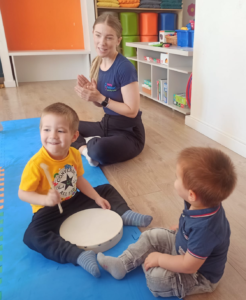
Encouraging lots of two-handed play — such as rolling balls, banging drums, or building with blocks — helps strengthen the communication between the two hemispheres through the corpus callosum, a vital brain bridge that supports coordination, communication, and learning.
Supporting Hand Development at Home
You can nurture your baby’s fine motor and coordination skills with simple everyday activities:
-
🎨 Messy play – let them explore with both hands using paint, sand, or playdough.
-
🍌 Self-feeding – finger foods encourage hand-eye coordination and grip control.
-
🎶 Baby College activities – action songs, beanbag games, and ribbon play help strengthen both sides equally.
-
🧩 Stacking and sorting – puzzles and blocks build precision and control in both hands.
As your child grows, you may notice one hand taking the lead in activities such as drawing, throwing, or brushing teeth — that’s their unique hand preference emerging naturally.
Fun Fact!
Even before birth, ultrasound studies show that some babies suck their right or left thumb more often, hinting at early hand dominance!
At Baby College
Our classes are designed to encourage equal use of both sides of the body through songs, games, and gentle bilateral movement — helping little ones build the neural connections that will later support writing, dressing, and even sports skills.
Every wiggle, clap, and high-five strengthens those cross-brain connections — and helps your baby’s growing mind and body work beautifully together.
👉 Explore more fascinating insights on baby development at www.babycollege.co.uk/parenting-articles
#BabyDevelopment #Handedness #ParentingTips #BabyCollegeFamily #BabyClassesNearMe #EarlyLearning